“The Tools”: Coping Strategies For When Things Feel Overwhelming
People often come to therapy looking for coping tools. There are so many tools out there that it can start to feel overwhelming pretty quickly, so I wanted to gather some of my favourites from different therapeutic approaches all in one place.
Coping tools can be incredibly helpful in difficult moments. I always suggest trying out different options and keeping a short list of go-to tools in your back pocket (or saved in your notes app) for when you need them.
At the same time, tools can only do so much. While they can help you feel more regulated in the moment, it’s also important to explore and address the deeper, underlying reasons why your nervous system gets overwhelmed in the first place.
With that said, here are some of my favourite therapeutic tools. I have seen these strategies help countless clients, and they have also been invaluable on my own journey.
Cognitive Defusion (from Acceptance and Commitment Therapy)
What it helps with: Getting unstuck from overwhelming or self-critical thoughts
How it works: It helps you see thoughts as mental events, not facts.
How to try it:
Notice the thought that’s looping or causing distress.
Add the phrase: “I notice I’m having the thought that…”
Gently remind yourself: “This is a thought, not a truth.”
That’s it! Sometimes the simplest tools are the most effective.
TIPP Skills (from Dialectical Behavioural Therapy)
What it helps with: Quickly calming intense emotions
How it works: TIPP skills use our bodies’ natural systems to bring the nervous system down from a high state of activation.
These skills are especially helpful when emotions feel urgent, explosive, or unmanageable.
How to try it:
Temperature: Splash cold water on your face or hold an ice pack to your face.
Intense Exercise: Move your body briskly for 30–90 seconds (think jumping jacks, a quick sprint, or some pushups).
Paced Breathing: Breathe slowly, making your exhale longer than your inhale.
Paired Muscle Relaxation: Tighten and release muscle groups.
RAIN (Tara Brach)
What it helps with: Responding to difficult emotions with compassion
How it works: It builds awareness and self-soothing instead of avoidance.
How to try it:
R – Recognize: Notice what’s present (emotion, sensation, thought).
A – Allow: Let it be there without pushing it away.
I – Investigate: Gently ask, “What do I need right now?”
N – Nurture: Offer yourself warmth, reassurance, or care.
Chain Analysis (from Dialectical Behavioural Therapy)
What it helps with: Understanding reactions after they happen
How it works: Chain analysis breaks down an experience step by step so patterns become clearer.
Instead of asking “What’s wrong with me?” this tool helps shift toward “What happened, and what makes sense here?”
How to try it:
Start with an unwanted outcome (feeling depressed, yelling at partner)
Slowly move backwards, like rewinding a movie, frame by frame. Write down events, thoughts, feelings, body sensations, and actions that led up to the unwanted outcome
Look for points in the chain where you might change the outcome next time by using a healthy coping tool
Challenging Automatic Thoughts (from Cognitive Behavioural Therapy)
What it helps with: Reducing harsh, distorted, or unhelpful thinking
How it works: It checks thoughts for accuracy and balance, reminding us thoughts are not facts.
How to try it:
Identify the negative or automatic thought.
Ask: Is this 100% true?
Look for evidence for and against the thought.
Check for cognitive distortions.
Create a more balanced or realistic thought.
Butterfly Hug (Bilateral Stimulation)
What it helps with: Grounding and emotional regulation
How it works: Alternating left-right tapping helps connect both sides of the brain and signals safety to the nervous system.
How to try it:
Cross your arms over your chest.
Gently tap left, right, left, right.
Breathe slowly as you tap.
Continue for 30–60 seconds or until you feel more settled.
IFS Parts Check-In (from Internal Family Systems)
What it helps with: Understanding different feelings and reactions, reducing internal tension
How it works: It helps you notice and listen to different parts of you, instead of judging or fighting them.
How to try it:
Pause and notice what’s coming up inside.
Ask: “What part of me is here right now?”
Notice how it feels in your body and what it wants you to know.
Thank the part for trying to help.
Remind it you’re listening and you don’t need to push it away.
Somatic Tools (Body-Based Regulation)
What it helps with: Releasing stress and supporting regulation
How it works: These tools send calming signals from the body to the brain, helping the nervous system shift out of fight-or-flight.
How to try it:
Rocking: Gently rock side to side or forward and back.
Humming: Hum slowly for 30–60 seconds.
“Voo” Sound: Take a deep breath and slowly say “vooooo,” feeling vibration in your chest.
Shaking: Gently shake out arms, legs, or your whole body.
5-4-3-2-1 Grounding
What it helps with: Feeling more present during anxiety or dissociation
How it works: Engaging the senses helps orient the brain to the present moment and reduces threat-based activation.
How to try it:
5: Name 5 things you can see.
4: Name 4 things you can feel or touch.
3: Name 3 things you can hear.
2: Name 2 things you can smell.
1: Name 1 thing you can taste or 1 thing you are grateful for
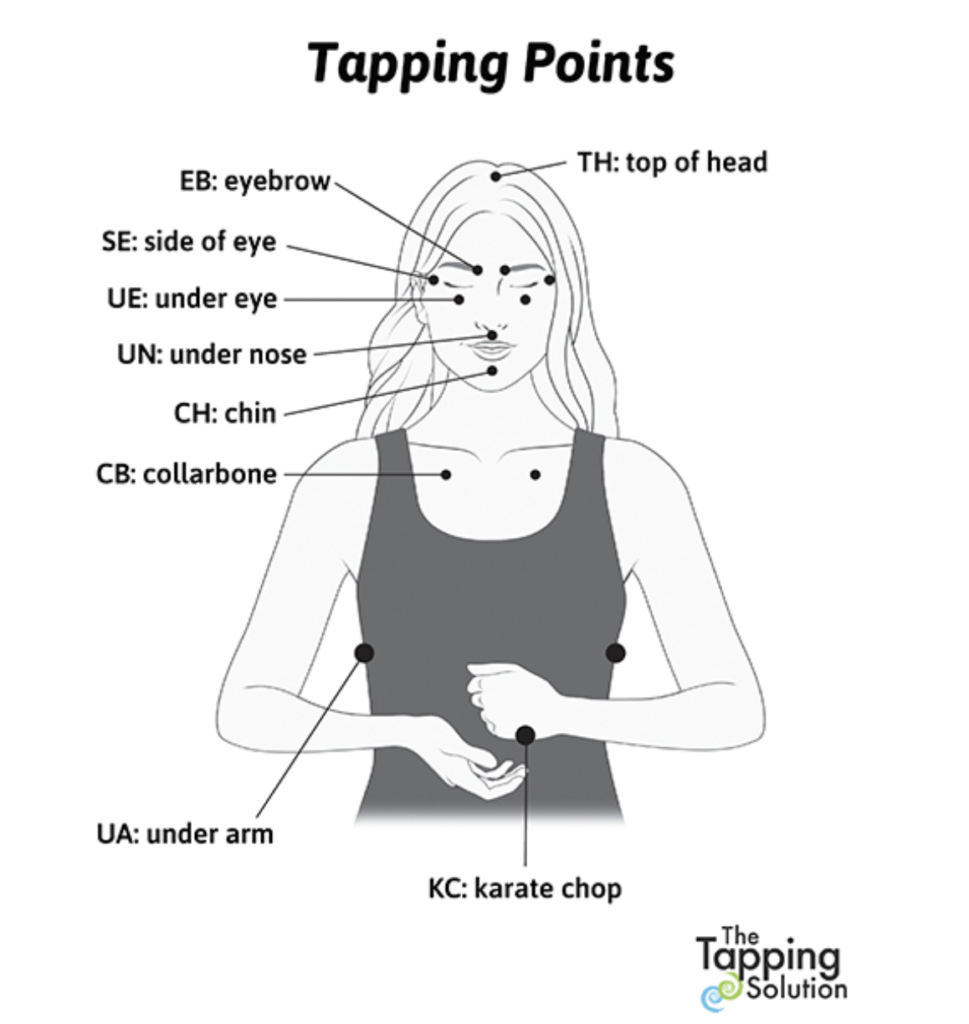
EFT Tapping (Emotional Freedom Technique)
What it helps with: Reducing emotional distress and stress in the body
How it works: Tapping on acupressure points while focusing on a feeling helps calm the nervous system.
How to try it:
Tap the points in sequence starting from the top of your head and moving down, repeating a simple phrase like: “Even thought I feel ________, I deeply love and respect myself”.
Continue for 1–2 minutes and notice any shifts.
Mental Health Apps
Finch (gamefied self-care!)
FreeCBT (thought log/challenging automatic thoughts)
Insight timer (guided meditations)
Calm (guided breathing exercises, meditations and other tools)
Daylio (tracking moods and triggers)
Clue (tracking menstrual cycle and symptoms)
Looking for a therapist in Duncan, BC or online in Canada?
I offer trauma-informed therapy for adults, drawing from approaches that help you reconnect with yourself and move toward healing in a gentle, compassionate way. Whether you’re local to Duncan or elsewhere in Canada, online sessions make it possible to access support from the comfort of your own space. You can learn more about my approach here, or book a free consult using the button below.